
The truck pulls away, the crew waves goodbye, and suddenly you're standing in a new house surrounded by forty, sixty, maybe a hundred boxes. We've seen that look on thousands of faces since 2011. It's a mix of relief and "where on earth do I start?"
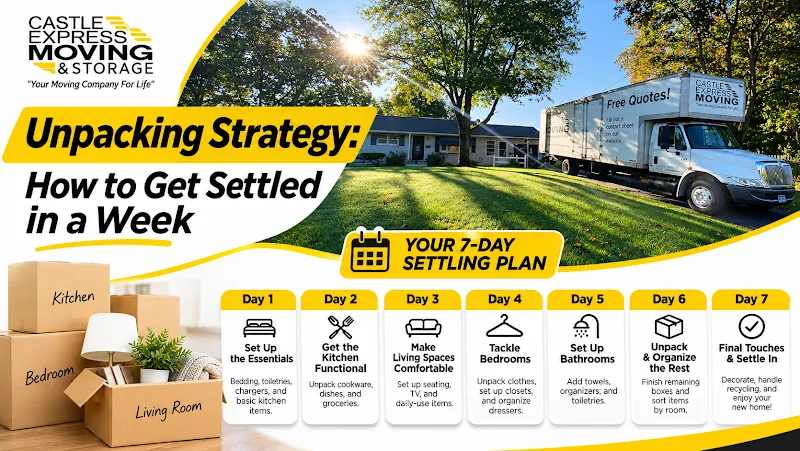
Here's the honest truth from our crews: the families who settle in fastest aren't the ones who work the hardest. They're the ones who unpack in the right *order*. Unpacking without a plan is how boxes end up sitting in the garage for two years. Unpacking with a plan is how you're hosting Sunday dinner by the end of your first week.
Below is the same seven-day unpacking strategy we share with our own customers after a residential move across Hartford County and Western Massachusetts.
Before Day One: Set Yourself Up While the Truck Is Still Here
Good unpacking actually starts weeks earlier, at the packing stage. Every item you didn't move is one you don't have to unpack, which is why we always recommend working through our guide on how to declutter before a move. And clearly labeled boxes, marked with the room *and* a short list of contents, cut unpacking time dramatically. (If you want more on that, our crew's 10 packing tips from professional movers covers labeling in detail.)
On move day itself, do three things before the crew leaves:
- Direct every box to its room. Stand at the front door, or tape a simple room name to each doorway. A box that lands in the right room on move day saves you from carrying it again later.
- Get the beds set up. Ask the crew to put beds in place before they go. After a long day, a made bed is worth more than anything else in the house.
- Find your "open first" box. This is the box you packed last and keep with you: phone chargers, toilet paper, a shower curtain, towels, medications, basic tools, snacks, paper plates, and a change of clothes for everyone. Our moving supplies checklist has a full rundown of what belongs in it.
That's it for move day. Don't try to unpack anything else tonight. Eat takeout, make the beds, and get some sleep.
Day 1: The Kitchen (Yes, First)
We know it's tempting to start with the easy rooms. Don't. The kitchen is the hardest room to unpack, and it's also the room that makes a house function. Until you can make coffee, pack a lunch, and cook a simple dinner, you'll feel like you're camping.
Tackle it in this order:
- Everyday dishes, glasses, and silverware first. Just enough for the household for a few days.
- Cookware and small appliances you use daily. Coffee maker, toaster, one good pan, one pot.
- Pantry and fridge staples. If you followed our tips on packing small kitchen appliances and pantry items, these boxes should be clearly marked.
- Everything else last. The fondue set, holiday platters, and the waffle iron can wait until the weekend.
Before you put anything in a cabinet, wipe the shelves down and think about workflow: glasses near the sink or fridge, pots near the stove, spices within arm's reach. It's much easier to get it right now than to reorganize in a month. And if you packed fragile pieces the way we recommend in our guide to packing a kitchen, unwrap them over a counter or table, never over a hard floor.
Day 2: Bedrooms and Closets
With the beds already set up from move day, Day 2 is about making bedrooms feel like bedrooms.
- Hang clothes first. If you used wardrobe boxes, this part takes minutes. Our guide on how to pack clothes for moving explains why those boxes are worth every penny.
- Fill dressers next, then put out nightstand essentials: lamps, alarm clocks, chargers, a book.
- Hang window coverings. Even a temporary shade makes a room more livable and gives you privacy from day one.
Moving with kids? Do their rooms first, before yours. Familiar bedding, favorite stuffed animals, and the nightlight make a huge difference in how quickly children adjust. We cover this more in our post on moving with kids.
Day 3: Bathrooms and Linens
Bathrooms are small, quick wins, which is exactly what you need on Day 3 when your energy starts to dip.
- Stock toiletries, medications, and cleaning supplies.
- Put fresh towels and bath mats out.
- Unpack the linen closet: sheets, spare blankets, and extra towels.
This is also a good day to do a quick check of the house: test smoke detectors, find the main water shutoff and electrical panel, and make sure every door and window locks.
Day 4: Living Room and Electronics
Now that the essentials are working, it's time to make the house feel like *home*.
- Finalize furniture placement before anything goes on a wall. Rugs go down first, then furniture on top.
- Set up the TV, internet router, and entertainment center. Plug in, test, and label cords while you're at it.
- Unpack books, throw pillows, and blankets.
Hold off on hanging art for now. You'll make better decisions once you've lived with the furniture for a few days.
Day 5: Home Office, Laundry, and Utility Spaces
If anyone in the house works from home, the office moves up on the priority list. Set up the desk, chair, monitor, and printer, and get your paperwork into a filing drawer so important documents don't get lost in the shuffle.
Then move to the laundry room and utility closets: detergent, the vacuum, the ironing board, the step stool. These are the items you'll suddenly need at 9 p.m. on a Tuesday.
Day 6: Garage, Basement, and the "Maybe" Boxes
Every move has them: the boxes that you weren't quite sure about. Day 6 is decision day.
Go through the garage and basement boxes and sort them into three piles: use it now, store it, or let it go. Seasonal gear, holiday decorations, and sentimental items can go on shelves or into labeled bins.
If you're downsizing and simply don't have room yet, or you're waiting on a renovation, don't let those boxes take over your new garage. Our climate-controlled storage in Enfield, CT is a secure, clean place to keep belongings until you're ready for them. This is especially common for families downsizing from a house to an apartment.
Day 7: Art, Decor, and Breaking Down the Last Boxes
The finish line. Today is about the personal touches and clearing out what's left.
- Hang art, mirrors, and family photos.
- Unpack decorative pieces and fragile keepsakes.
- Break down every empty box. Pass good-condition boxes along to a friend, neighbor, or local buy-nothing group, and recycle the rest through your town's recycling program. Our post on eco-friendly moving in Connecticut has more ideas for keeping moving materials out of the landfill.
- Update your address with the post office, banks, and subscriptions if you haven't already. Our Connecticut moving checklist includes a full first-week-after list so nothing slips through.
Then sit down, look around, and enjoy it. You're home.
Five Unpacking Rules Our Crews Swear By
After more than a decade of watching families settle in, here's what separates a one-week unpack from a one-year unpack:
- One room at a time. Opening a box in every room makes the whole house feel chaotic. Finish a room before starting the next.
- Unpack, don't just un-box. Every item needs a home. If you don't know where something goes, it's a sign you may not need it.
- Set a daily time limit. Two or three focused hours a day beats one exhausting 12-hour marathon.
- Keep a box-cutter station and a trash bag in every room. Packing paper piles up fast.
- Don't buy organizers until you've unpacked. You won't know what you actually need until everything's out of the box.
When It Makes Sense to Get Help Unpacking
A week is very doable for most families. But sometimes life doesn't leave you a free week: a new job starts Monday, you're relocating from out of state, or you're helping a parent through a senior transition.
That's where professional help comes in. Our packing services include unpacking at your new home, so you're not living out of boxes. And when packing is done well from the start, with the room-by-room labeling we use in our boutique Princess Packing™ service, unpacking goes faster no matter who's doing it.
For older adults, we also offer dedicated senior moving with a patient, careful crew who understand that a new home should feel familiar as quickly as possible.
Frequently Asked Questions About Unpacking
How long should it take to unpack after a move?
For a typical two- to three-bedroom home, most families can be fully settled in about one week by following a room-by-room plan. Without a plan, it's common for unpacking to stretch on for months.
What room should you unpack first?
We recommend the kitchen, right after setting up beds on move day. It's the room your household depends on most, and getting it working makes every other day easier.
Do movers unpack for you?
Many full-service movers offer unpacking as an add-on. At Castle Express, unpacking services are available at your new home. Just ask when you request your free estimate.
What should go in an "open first" box?
Toilet paper, towels, a shower curtain, medications, phone chargers, basic tools, snacks, paper plates, and a change of clothes for each person. Keep it with you in the car, not on the truck.
Let's Get You Settled
A smooth unpack starts with a smooth move. Whether you're moving across town in Enfield or relocating to Connecticut from out of state, our family-owned team will make sure every box lands in the right room and your home is ready to live in.
Get your free estimate or call us at 1-888-553-4503. We typically respond in 20 minutes or less.