
Get three long-distance moving quotes for the same house and you will usually get three very different numbers. One looks suspiciously cheap, one seems high, and the third lands somewhere in the middle. Customers calling our Enfield office ask about this all the time: if the job is the same, why aren't the prices?
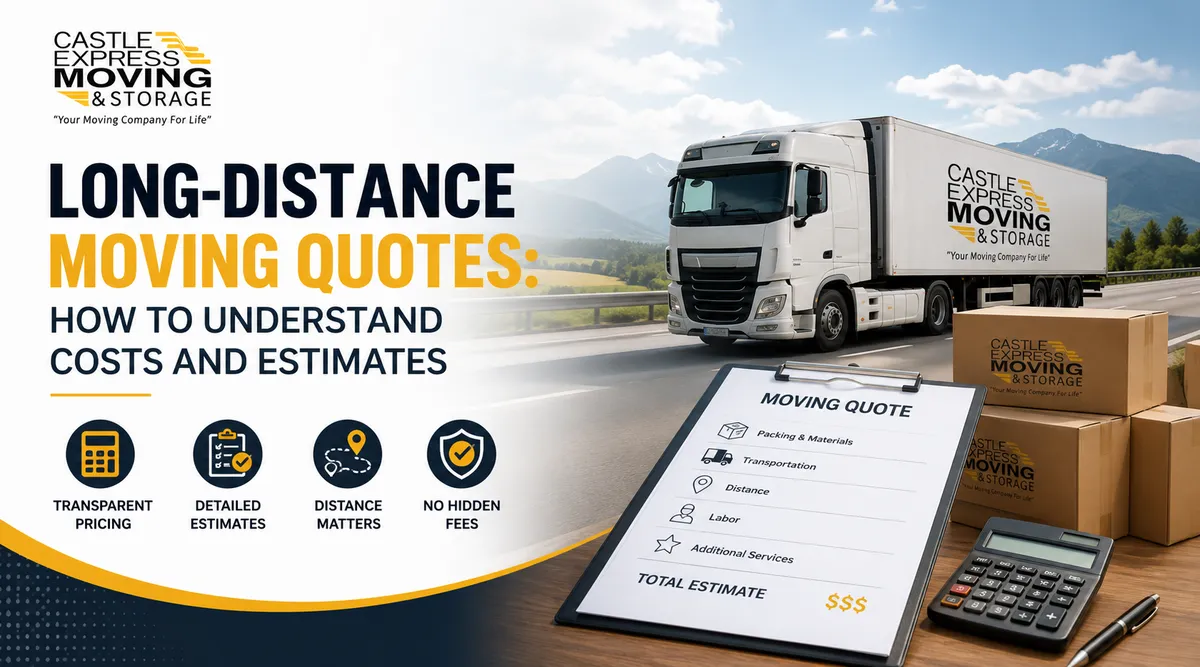
This post explains how long-distance moving quotes are actually built — weight, mileage, services, and timing — so you can read an estimate the way a mover does and spot a bad one before you sign it. If you're after the service itself rather than the how-to, our long-distance moving page covers how we run interstate jobs out of Connecticut and Western Massachusetts.
How Long-Distance Moving Quotes Are Priced
Local moves in Connecticut are usually billed by the hour. Long-distance moves work differently: the price is built from the weight or volume of your shipment, the distance it travels, and the services you add on. (If you're comparing a local job instead, our guide to what movers cost in Connecticut has current hourly ranges.)
Four things drive the number:
Distance and route. Fuel, tolls, and driver hours add up over long miles. A shipment from Hartford County to Florida prices differently than the same load going to the Carolinas, even if the truck is packed identically.
Weight or volume. A one-bedroom apartment costs far less to ship than a four-bedroom colonial. Every pound you don't move is money you don't spend, which is why decluttering before the move is the single easiest way to shrink a long-distance quote.
Services. Full packing, custom crating for art and glass, furniture disassembly, and storage in transit all show up as line items. None of them are wrong to buy — you just want them itemized so you can see exactly what you're paying for.
Timing. Summer weekends and end-of-month dates book out weeks ahead in our area and cost the most. A flexible date in the shoulder season is the cheapest lever most people never pull.
The Three Types of Estimates
Movers issue three kinds of estimates, and the type matters as much as the number printed on it.
A binding estimate locks the price to the inventory and services listed. If nothing changes, the price doesn't either. A non-binding estimate is an educated guess — your final bill can go up or down based on actual weight, which is where unpleasant surprises live. A binding not-to-exceed estimate is the most customer-friendly of the three: if your shipment weighs in lighter than expected you pay less, and if it weighs in heavier you still pay the quoted cap.
Whichever type you're offered, get it in writing after an in-home or video survey. A number quoted over the phone without anyone looking at your belongings is a guess, not an estimate. At Castle Express we do a full walkthrough before we put a number on paper, and we aim to come within 10% of every estimate we give. Our post on how to read a moving estimate walks through the paperwork line by line.
What Basic Coverage Actually Pays
Federal law requires every interstate mover to include released-value coverage at 60 cents per pound per item. That sounds like protection until you do the math: a 50-pound TV that breaks pays out $30.
For a truck that's on the road for days, full-value protection is usually worth pricing out. Our version, Castle Care, runs $10 per $1,000 of declared value (minimum $100, maximum $2,500). Ask about both options when you request your estimate, and make any company you're considering explain theirs in plain terms.
Red Flags in a Long-Distance Quote
Not every mover operates honestly, and long-distance jobs are where the worst surprises happen. Be cautious if you see:
- A flat rate far below several comparable written estimates. Legitimate movers price from the same weight and mileage, so their numbers cluster. One dramatic outlier is a lure, not a deal.
- Demands for a large cash deposit before anyone has surveyed your home.
- No USDOT number. Every interstate mover must have one, and you can verify it free at fmcsa.dot.gov, along with the company's complaint history and insurance status. Ours is 2307446.
- Vague answers about who shows up. Ask whether the crew loading your truck works for the company you hired or whether your move is being brokered out to a third party.
How to Get an Accurate Quote
The accuracy of your quote depends mostly on what you tell the mover. Provide a complete inventory, including the garage, attic, and basement. Request an in-home or virtual survey instead of accepting a phone guess. Ask directly about stairs, long carries, shuttle service, and storage charges. Then collect at least three written estimates so you can see where fair market pricing sits.
At Castle Express, estimates are free, they go out in writing, and we typically respond within 20 minutes during business hours. For a fuller walkthrough of an interstate move out of this region — timelines, packing, storage in the middle — see our guide to long-distance moves from CT and MA.
Frequently Asked Questions
How far in advance should I book a long-distance move?
Four to eight weeks is the sweet spot, and earlier is better between May and September. Early booking secures your preferred date and usually better pricing.
Why do quotes vary so much between companies?
Different estimate types, different included services, and different levels of honesty. The cheapest number often excludes fees the mover plans to add later — compare what's in writing, not just the total.
Is my stuff insured during a long-distance move?
Every interstate mover includes released-value coverage at 60 cents per pound per item, which is minimal. Full-value protection costs more and is usually worth it on a long haul. Confirm coverage details before signing.
Once you know what's behind the number, comparing quotes stops feeling like a guessing game. Request a free written estimate or call 1-888-553-4503 — we've been pricing long-distance moves out of Enfield since 2011, and we stand behind every number we put on paper.