
The worst moving-day story usually starts the same way: the crew has your furniture on the truck, and suddenly the price has doubled. Pay up, or the truck doesn't move. Connecticut sees its share of moving scams—from fly-by-night operators who rent a truck and disappear to serial companies that change names and repeat the same scheme across state lines. By the time you realize something's wrong, your belongings are already loaded.
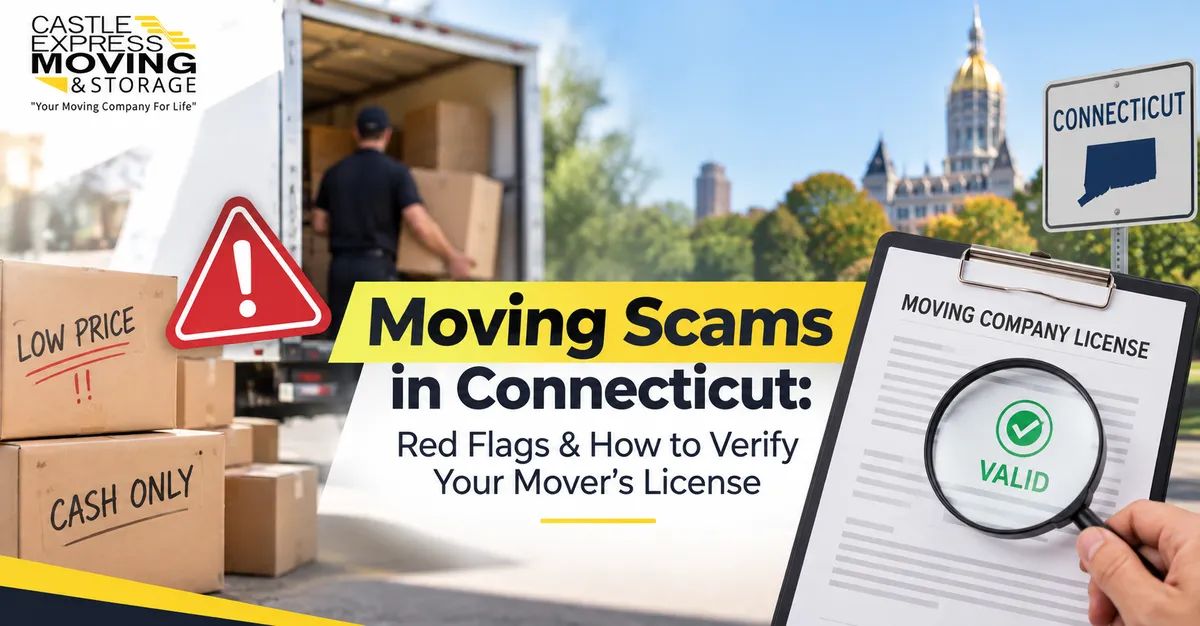
You can protect yourself, and it takes about 30 minutes. This guide walks through the red flags that signal a moving scam and shows you exactly how to verify a mover's license in Connecticut—both the state certificate for local moves and the federal registration for interstate moves—before handing over your money.
Why Moving Scams Happen in Connecticut
Connecticut's moving market is competitive. Along the corridors between Hartford, New Haven, and the Massachusetts border, licensed movers operate alongside operators who have no certificate, no insurance, and no intention of sticking around. The most common targets are people moving out of state (harder to chase down afterward), seniors downsizing or relocating to assisted living, busy professionals who don't have time to inspect quotes, and anyone on a tight timeline who accepts the first estimate they get.
7 Red Flags That Signal a Moving Scam
1. No Physical Office or Business Address
A legitimate moving company has a warehouse, trucks, and an address you can drive past. If a company only communicates by phone or email, can't give you a street address, or lists a UPS mailbox as headquarters, they have nothing to lose by ripping you off. Look up the address on Google Maps and check for real photos and reviews. Castle Express, for example, is based in Enfield—you can find us.
2. Demands for a Large Cash Deposit or Full Payment Upfront
The red flag: The company insists on full payment before moving day, or demands a large deposit by wire transfer, cryptocurrency, cash app, or cash.
Why it matters: Reputable movers charge the bulk of the bill when the work is done. A reasonable deposit to hold your date is modest—and payable by credit card or check, which gives you recourse. Someone demanding a big untraceable payment before a single box is loaded is often planning to take the money and vanish.
What to do: Pay any deposit by credit card, get the refund policy in writing, and walk away from anyone who pushes cash, wire transfers, or full prepayment.
3. A Quote Far Below Everyone Else's
Cheap is how they hook you. Scammers quote low to win the job, then hold your belongings hostage for "unexpected" charges on moving day—the classic lowball estimate. The number itself isn't the tell, because a small local move billed hourly can legitimately come in far cheaper than a long-distance move. The tell is comparison: get three or four written estimates, and if one sits far below the rest—especially a flat-rate bid on a long-distance move—ask hard questions about what's included and how the price was calculated. Our breakdown of what movers actually cost in Connecticut gives you realistic hourly rates to compare against. An in-home or video survey makes any estimate more trustworthy; a price quoted sight-unseen should make you cautious.
4. No Binding Written Estimate
The red flag: The company won't put an estimate in writing, or emails a one-line quote with no details.
Why it matters: A written estimate protects you. If a mover quotes "approximately $4,000" with nothing on paper, they can charge $7,000 on moving day and call the original number a guess. (For what it's worth, our policy at Castle Express is every estimate in writing, with the goal of landing within 10% of it.)
What to do: Insist on a detailed written estimate that spells out how the cost is calculated (hourly or by weight), what's included and excluded, travel or mileage charges, and the liability coverage on your goods.
5. Evasiveness About Insurance and Liability
Ask two direct questions: "Are you insured?" and "What coverage applies to my belongings if something is damaged?" A legitimate mover answers both without flinching and will hand over a certificate of insurance on request—you can even call the insurer to confirm the policy is active. A scammer gets vague, defensive, or claims they "don't need" coverage, because they have no intention of honoring a claim. If the certificate doesn't appear, neither should your signature.
6. Thin or Nonexistent Online Presence
Even small, honest moving companies have a basic website and a trail of reviews. Scammers operate under rotating company names precisely to shed their bad reviews, so a "company" with no history is a warning. Google the name plus "reviews," "complaints," and "scam." Check bbb.org for their grade and complaint history, and confirm the company name, address, and phone number match across platforms. Brand new with zero reviews isn't automatically a scam—but it means you should verify everything else twice.
7. Requests for Personal Financial Information Upfront
The red flag: The company asks for bank account details or your Social Security number before you've signed anything.
Why it matters: That's an identity-theft setup, not a moving quote. No mover needs your SSN, ever.
What to do: Share nothing beyond normal credit card payment details, and only at the point of an actual, contracted transaction.
How to Verify a Connecticut Mover's License
This is the part most people get wrong, because Connecticut has two different systems depending on where you're moving.
Moving within Connecticut: Intrastate household goods movers are required to hold a Household Goods Carrier certificate from the Connecticut Department of Transportation. Ask the mover for their certificate number—a licensed company will give it to you without hesitation—and verify it with CT DOT. No certificate, no job. This one question filters out most illegitimate operators in about ten seconds.
Moving out of state: Interstate movers must be registered with the Federal Motor Carrier Safety Administration and have an active USDOT number.
Step 1: For In-State Moves, Verify the CT DOT Certificate
- Ask the company directly for their Household Goods Carrier certificate number
- Contact CT DOT to confirm the certificate is active and issued to that company name
- Confirm the business name and address on the certificate match the company you're actually dealing with
If they stall, claim they "don't need" a state certificate for local moves, or offer a Secretary of State business registration instead—that's not the same thing—keep shopping. Being a registered business tells you a company exists on paper; the CT DOT certificate is what authorizes it to move household goods for hire.
Step 2: For Interstate Moves, Check the FMCSA Database
- Go to fmcsa.dot.gov and use the carrier search
- Enter the company name or USDOT number
- Confirm the status is Active—not "Out of Service" or "Inactive"—and look for a clean safety record with no recent violations
The carrier record should show a consistent company name and address matching what you were given. A USDOT number with "Out of Service" status means they are not currently authorized to move you.
Step 3: Check Reviews and the BBB
Look the company up on bbb.org and read the recent complaints, especially unresolved ones—a mover with dozens of ignored complaints has told you how they handle problems. Then check Google reviews for volume and recency. Castle Express holds an A+ BBB rating and 4.9 stars on Google across more than 200 reviews; you don't need to take any mover's word for their reputation, including ours.
Step 4: Ask for Proof of Insurance
Request a certificate of insurance and confirm with the insurer that the policy is active. You can also ask to be named as a certificate holder for your move. A company that hesitates on this step is a company to skip.
Questions to Ask Before Hiring
Once the credentials check out, work through these 8 questions to ask a moving company before you book. The short version:
- What's your CT DOT Household Goods Carrier certificate number (or USDOT number for interstate moves)?
- Can you provide a binding written estimate?
- What liability coverage applies to my belongings?
- What's included in the quote, and what costs extra?
- Do you have references from moves similar to mine?
- What's your cancellation and refund policy?
- How do you handle damage claims?
- Will the crew that shows up actually work for your company, or is the job subcontracted?
Legitimate movers answer all eight clearly and without defensiveness.
Three Connecticut Scams to Watch For
The "storage hold." A mover picks up your belongings, then claims you owe additional charges and refuses to release your items from storage until you pay. Protect yourself by getting the final balance in writing before moving day, along with exactly when and where delivery happens.
The "moving day surprise." The crew arrives and announces the price has doubled because of stairs, distance, or "extra items"—payable in cash, right now, or nothing gets loaded. This is why the binding written estimate matters: a legitimate mover explains any overage against the estimate before the work continues, not with your sofa held hostage.
The "lost in transit." Items disappear during the move and the company stonewalls every claim. Photograph your belongings before the move, keep an inventory list, and choose a mover whose reviews show they actually resolve claims.
Choosing a Mover You Won't Have to Worry About
The full playbook is in our guide to how to choose a moving company in Connecticut, and the pattern is simple: verify the CT DOT certificate or USDOT number, get multiple written estimates, read recent reviews, ask for references, and sign a binding contract with every term on paper. For the pricing traps specifically, see how to avoid getting burned by a moving company. Legitimate movers have nothing to hide and will welcome every one of these checks.
If You Suspect a Scam
Report it. For moves within Connecticut, file a complaint with the Connecticut Department of Transportation or the Connecticut Department of Consumer Protection. For interstate moves, file with the FMCSA at fmcsa.dot.gov. The Better Business Bureau accepts complaints in both cases, and if you've already lost money, the FBI's Internet Crime Complaint Center (ic3.gov) and a consumer protection attorney are the next calls.
Move With Confidence
Thirty minutes of verification is all it takes: one certificate number, a few written estimates, and a quick read of the reviews. If you'd like one of those estimates from a company you can check out top to bottom, Castle Express Moving has been serving Hartford County and Western Massachusetts since 2011—licensed, insured, and A+ rated with the BBB. Visit our residential moving services page to see how we work, or request a free written estimate and we'll typically respond within 20 minutes. No surprises, no games.