
For most businesses, a move costs a weekend. For a restaurant, a bad move can cost a month. Every day the doors stay closed is a day of lost covers, idle staff, and regulars who start finding somewhere else to eat. And unlike an office, you can't just plug in the laptops on Monday morning. A commercial kitchen has gas lines, refrigeration, hoods, fire suppression, grease traps, and a health inspector who has to sign off before you serve a single plate.
The good news is that the weeks most restaurants lose during a relocation are rarely lost on moving day itself. They're lost in the gaps: waiting on an inspection that nobody scheduled, a walk-in cooler that won't fit through the new back door, or a range that arrives before the gas line is ready. In this guide, we'll walk through how we plan a restaurant relocation so the equipment move takes a day or two, and the reopening follows right behind it.
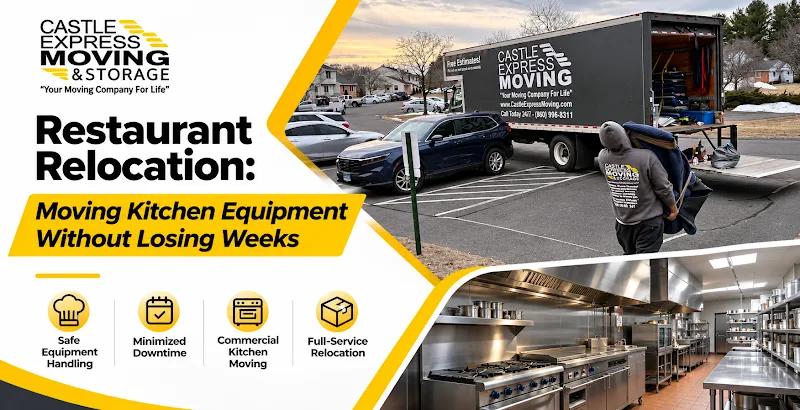
Why Restaurant Moves Stall (And Where the Time Really Goes)
When we talk to restaurant owners about a relocation, the truck and the crew are usually the smallest part of the timeline. The real delays come from three places:
- Permits and inspections. In Connecticut, food service licenses are issued by the local health department or health district, and they're tied to a specific location. A new address usually means a plan review, a pre-opening inspection, and sign-off from the fire marshal and building department. If those aren't lined up before the move, your equipment can sit in a finished kitchen for weeks waiting on paperwork.
- Trades that aren't sequenced. Gas fitters, electricians, plumbers, refrigeration techs, and hood and fire-suppression contractors all have to touch your kitchen, often in a specific order. When they're booked reactively instead of on a shared schedule, each one becomes a bottleneck.
- Equipment that wasn't measured. Walk-in coolers, combi ovens, and six-burner ranges don't care what the lease says. If a piece won't clear a doorway, a stairwell, or a turn in the hallway, you'll find out on move day unless someone measures first.
This is the same core problem we write about in our guide to minimizing downtime during an office move in Connecticut: the move itself is predictable; the downtime comes from everything around it.
Start With the New Space, Not the Old Kitchen
Our first step on any restaurant job is a walkthrough of both locations, but the new space matters more. Before anything gets disconnected, we want to know:
- Access and path of travel. Door widths, loading areas, stairs, elevators, and tight corners between the street and the kitchen line.
- Utility readiness. Are the gas stubs, dedicated circuits, water lines, and floor drains already in place where the equipment layout calls for them?
- Hood and suppression status. Is the hood installed, and has the fire-suppression system been inspected and tagged for the new line?
- Grease management. If the building is on public sewer, your local water pollution control authority may have fats, oils, and grease (FOG) requirements, including a grease interceptor, that need to be in place before you open.
- Floor plan. A scaled layout that shows where every piece goes, so our crew can place equipment once instead of shuffling it around a half-finished kitchen.
If the new space isn't ready, the smartest move is often to wait a week on the equipment move rather than shut down early and pay rent on two dark kitchens.
Your Restaurant Relocation Timeline (Working Backward From Reopening)
We always plan a restaurant relocation backward from the reopening date, not forward from the lease. Here's the timeline we recommend:
8 to 12 weeks before reopening
- Contact the health department that covers your new location and ask what they need for plan review. Most Connecticut health departments ask for a scaled floor plan, an equipment list, and your menu.
- Talk to the fire marshal and building department about hood, suppression, and occupancy requirements.
- Get a moving estimate based on a real walkthrough, not a phone guess. Our post on what happens after you request a moving estimate explains exactly how we build one.
4 to 6 weeks before
- Book your trades (gas, electrical, plumbing, refrigeration, hood and suppression) on a single shared schedule.
- Confirm your POS, internet, and phone install date at the new address. Internet lead times catch restaurants just as often as offices, and our office relocation checklist for IT setup and downtime prevention covers the same steps you'll need for your front of house.
- Decide what's moving, what's being replaced, and what's being sold or scrapped.
2 weeks before
- Schedule the pre-opening health inspection for the earliest realistic date after the equipment move.
- Start running down perishable inventory and plan your final service.
- Pack everything that isn't needed for your final days: back stock, smallwares, decor, paperwork.
Move week
- Close after your last service, disconnect, clean, move, reconnect, inspect, and reopen. We break that down day by day below.
If you have flexibility on dates, timing matters too. Peak residential season in our area runs May through September, and our guide to the best time to move in Hartford County explains how the calendar affects crew availability and pricing.
How We Move Commercial Kitchen Equipment
Commercial kitchen equipment is heavy, expensive, and often connected to gas, water, and refrigerant. It's much closer to specialty moving than to moving an office desk, and we treat it that way, with heavy-duty dollies, stair climbers, padding, and a pre-move assessment of every large piece.
Disconnection comes first, and it isn't ours to do
Gas appliances, hardwired equipment, and anything with refrigerant lines should be disconnected by licensed tradespeople. That's not us passing the buck; it's the law and common sense. We coordinate our arrival with your gas fitter, electrician, and refrigeration tech so equipment is safely disconnected and capped right before our crew loads it, not two days earlier.
Equipment-by-equipment prep
- Ranges, ovens, and fryers. Fully cooled, cleaned, and degreased. Fryer oil drained and disposed of properly. Grates, racks, and loose parts removed and packed separately.
- Reach-ins and refrigeration. Emptied, cleaned, and dried with doors secured. After transport, many manufacturers recommend letting refrigeration units stand upright for several hours before powering on so oils can settle. Check your equipment manual for the exact time.
- Walk-in coolers and freezers. These are typically disassembled panel by panel by a refrigeration contractor, moved as panels, and rebuilt at the new location. We plan the walk-in reassembly early in the sequence because it's often the longest single job.
- Ice machines. Drained, sanitized, and dried to prevent mold and odors in transit.
- Dish machines and combi ovens. Water lines drained and disconnected, with control panels protected.
- Stainless prep tables and shelving. Broken down where possible, with hardware bagged and labeled to the unit.
If you're moving larger production equipment like mixers, slicers, or bakery ovens, our post on moving manufacturing equipment safely goes deeper into rigging, sequencing, and heavy-machinery handling.
Smallwares, glassware, and the front of house
Plates, glassware, sheet pans, hotel pans, and utensils add up to hundreds of boxes in a busy restaurant. Our full-service packing team can pack these for you so your staff can keep cooking until the final service. If your team is packing on their own, our tips on how to pack fragile items for a move apply just as well to stemware and china as they do at home.
Label every box by station, not just by room. "Hot line," "pastry," "bar," and "dish" tell our crew exactly where to set things down at the new kitchen.
What we won't put on the truck
Propane tanks, CO2 cylinders, open containers of cleaning chemicals, and perishable food don't travel with your equipment. Our list of things movers won't move explains why, and what to do with each item instead.
A Sample Move Week That Keeps Closure to a Few Days
Every restaurant is different, but here's what a tight, well-sequenced restaurant relocation can look like:
- Day 1 (after final service): Final cleaning, perishables cleared out, smallwares packed. Trades disconnect and cap gas, electrical, and refrigeration lines.
- Day 2: Our crew loads and moves equipment in a planned order, walk-in panels and large line equipment first, smallwares last. Each piece is placed on its spot in the new floor plan.
- Day 3: Trades reconnect gas, power, water, and refrigeration. The walk-in is rebuilt and starts pulling down to temperature.
- Day 4: Equipment testing, hood and suppression checks, and stocking. Health and fire inspections, if scheduled ahead.
- Day 5: Soft opening or staff training service.
The key is that nothing on that list waits on a phone call. Every inspection and every trade was booked weeks earlier.
Use Storage to Bridge the Gap
Sometimes the old lease ends before the new kitchen is ready, or you're replacing some equipment and want to hang on to the old pieces until the new ones arrive. Instead of paying for a short-term lease extension, we can hold equipment, furniture, and boxed inventory (non-perishable only) in our climate-controlled storage facility in Enfield, CT. Climate control protects stainless finishes, electronics, wood dining furniture, and paper records from the humidity swings New England is known for.
What a Restaurant Relocation Costs
The price of a restaurant move depends on how much equipment you have, how difficult the access is at both locations, how many crew hours it takes, and whether you need after-hours or weekend work. We break down the biggest cost drivers in why commercial moving costs more for CT business owners.
One thing we always remind owners: the cheapest-looking hourly rate isn't always the cheapest move. A crew that's too small, underequipped, or unfamiliar with heavy equipment adds hours and risk. Our guide on how to read a moving estimate in Connecticut shows you what to look for before you sign.
Choosing Restaurant Movers in Connecticut and Western MA
When you're interviewing movers for a restaurant relocation, ask:
- Have you moved commercial kitchen equipment before, and what equipment do you use for heavy pieces?
- Will you do an on-site walkthrough of both locations?
- Can you work after hours or overnight so we don't lose extra service days?
- Do you use your own crews, or subcontractors?
- Are you licensed and insured, and can I verify it?
We cover more of these questions in our post on how to choose commercial movers in CT and MA. Castle Express is family-owned, uses our own crews, and holds USDOT 2307446 and CT Permit C-1768, so you can check our credentials before you ever book.
Planning a Restaurant Relocation? Let's Talk Early
The earlier we're involved, the more time we can save you. We handle commercial moving across Connecticut and Western Massachusetts, including restaurants, retail, and medical offices, from our home base in Enfield. Whether you're moving down the street in Hartford or across the state line to Springfield, you can check our full list of service areas to see if we cover your town.
Ready to plan your move? Request a free estimate, choose "Office / Commercial" as your move size, or call us at 1-888-553-4503. We'll walk both spaces with you and build a schedule that gets you back to serving customers as fast as possible.
Frequently Asked Questions
How long does a restaurant relocation take?
The physical equipment move usually takes one to two days. Total closure time depends on how quickly utilities can be reconnected and inspections completed. With permits and trades scheduled in advance, many restaurants can reopen within a week.
Do I need a new health license if I move my restaurant?
In most Connecticut towns, yes. Food service licenses are typically tied to a specific location, so moving usually means a plan review and pre-opening inspection with the local health department or health district. Contact the health department for your new address as early as possible.
Can movers disconnect gas and refrigeration equipment?
Gas, hardwired electrical, and refrigerant connections should be handled by licensed tradespeople. We coordinate our schedule with your gas fitter, electrician, and refrigeration contractor so equipment is disconnected right before loading and reconnected right after placement.
Can you move a walk-in cooler?
Yes. Walk-in coolers and freezers are usually disassembled into panels by a refrigeration contractor, then moved and rebuilt at the new location. We plan that work early in the move week because it often takes the longest.
Can you move our restaurant after hours?
Yes. We offer evening, overnight, and weekend scheduling for commercial moves so you lose as few service days as possible.
Can you store restaurant equipment between locations?
Yes. We offer climate-controlled storage in Enfield, CT for equipment, furniture, and non-perishable items when there's a gap between your old and new locations.