
Every week we get calls from families in Hartford County and Western Massachusetts who are halfway through planning a big move and already worn out by quotes. One company promises a price that seems too good to be true. Another wants a deposit before anyone has looked at the house. A third can't tell them when the truck will actually show up at the other end.
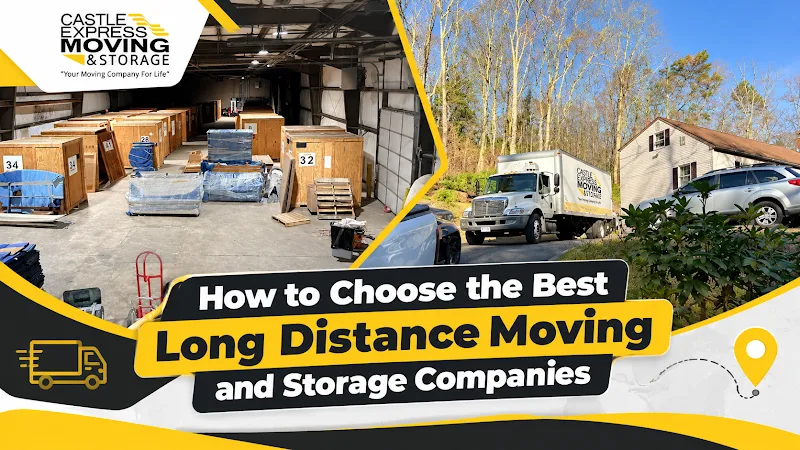
We've been moving families out of Connecticut since 2011, and we've heard enough stories from people who hired the wrong company to know that this one decision shapes everything else about a long-distance move. Add storage to the picture, because your closing dates don't line up or your new home isn't ready yet, and the stakes go up again. Your belongings could sit with that company for weeks or even months.
So here's the same advice we'd give a friend. Below we walk through how to vet long distance moving and storage companies, which federal rules protect you, and the questions that separate a real mover from a sales operation.
1. Confirm You're Hiring a Licensed Mover, Not a Broker
The moment your move crosses a state line, it falls under federal rules. Any company hauling household goods between states has to be registered with the Federal Motor Carrier Safety Administration (FMCSA) and should give you its USDOT and MC numbers without hesitation. You can look both up yourself on the FMCSA Protect Your Move site.
While you're checking, look at how the company is registered. A moving broker books your job and then hands it to another company to carry out. Brokers usually don't own trucks or employ movers, which means the people who show up on moving day may be strangers to the company you actually spoke with. That's not automatically a scam, but it does mean less control over who handles your things and who you call if something goes wrong.
A simple test we suggest: ask whose name will be on the side of the truck. A real carrier can answer that in one breath.
For moves that stay inside Connecticut, the state has its own rules. According to the Connecticut Department of Consumer Protection, in-state movers need a household goods certificate or permit from the Connecticut Department of Transportation, while interstate movers are regulated federally.
For the record, we're a licensed interstate carrier: USDOT 2307446, MC-990616 and CT Permit C-1768. We wrote a full guide on how to verify a mover's license in Connecticut if you want a step-by-step walkthrough.
2. Never Accept a Price Without a Survey
The FMCSA lists a phone or online estimate given sight unseen as one of the classic warning signs of a rogue mover. It makes sense when you think about it. Nobody can price a four-bedroom house across three states without knowing about the sectional in the basement, the piano in the living room or the 30 boxes of holiday decorations in the attic.
A trustworthy company will either visit your home or walk through it with you on a video call. That's how we handle every long-distance job. Penny or Monique from our team does a free in-home or video walkthrough, so the estimate reflects what's really moving instead of a guess that grows on moving day.
If you're comparing several quotes side by side, our guides on how long distance moving quotes work and how to read a moving estimate will help you spot what's included and what's missing.
3. Know the Difference Between Binding and Non-Binding Estimates
For interstate moves, the type of estimate you sign decides how much the mover can collect when your things arrive. Federal rules break it down like this:
- Binding estimate: The mover can't require you to pay more than the estimated amount at delivery for the goods and services listed.
- Non-binding estimate: This is the mover's best guess based on estimated weight and services. At delivery, the mover can't require more than 110 percent of the estimate. Any balance above that has to be billed later, not demanded before your belongings come off the truck.
There's one exception to watch for. On either type, the mover may collect extra at delivery for "impracticable operations" defined in its tariff, such as unexpected access problems, but those charges are capped at 15 percent of the other charges due. The FMCSA's estimate rules spell out the details.
Whatever you sign, get it in writing and make sure it clearly says binding or non-binding. Our article on how to estimate moving costs explains which factors push the final number up or down.
4. Ask Exactly How Your Belongings Will Travel
This is the question most people forget to ask, and it's often the one that matters most.
Many long-distance carriers consolidate several households onto one truck to fill it before heading out. That can stretch delivery into a window of a week or two, and some shipments get unloaded into a warehouse along the way. If you're closing on a house on a specific day, a vague delivery window can leave you sleeping on an air mattress.
Ask every company these questions:
- Will my shipment share a truck with other customers?
- Will my belongings be transferred to another truck or stored in a warehouse during transit?
- Do I get a firm delivery date, or a range?
- Who unloads at the destination?
We built our long-distance moving service around those answers. Every long-distance move gets its own dedicated truck, with no shared loads and no warehouse stop in between. You get a firm delivery date before we load. New England destinations like New Hampshire, Vermont and Maine are typically next day, the Carolinas take a couple of days, and Florida takes a few. If you're heading south, our guide to moving to Florida from Connecticut covers the rest of the planning.
We also compared the two business models in more depth in local movers vs. national chains in Connecticut.
5. Understand What Valuation Coverage Actually Pays
A lot of people assume their belongings are "insured" by the mover. On an interstate move, that's not quite how it works. Under federal law, interstate movers must offer two levels of liability, called valuation:
- Released Value: Included at no extra cost, but the mover is only liable for up to 60 cents per pound, per article. The FMCSA's own example is a 10-pound stereo component worth $1,000, which would pay out just $6. You must sign a specific statement to choose this option.
- Full Value Protection: The mover is liable for repairing, replacing or paying the current replacement value of lost or damaged items. Unless you sign for Released Value, your shipment moves under Full Value Protection by default. Pricing and deductibles vary by mover.
One more detail that trips people up: items worth more than $100 per pound, such as jewelry, fine china or silver, need to be declared to the mover in writing. Otherwise the mover can limit its liability on them. The FMCSA valuation page explains each option in plain language.
Ask every company for written details of its coverage before you book. Every Castle Express move includes standard cargo protection as required by federal law, and we offer Castle Care valuation coverage for higher-value moves. We go deeper on this topic in interstate moving insurance explained.
6. Look Just as Hard at the Storage Side
When a company says "moving and storage," that can mean very different things. Some own and run their own warehouse. Others load your things into a third-party self-storage unit or rent space from someone else. Before you sign, ask:
- Who owns and operates the storage facility?
- Is it climate-controlled, and what temperature and humidity range does it hold?
- Are my items sealed in containers, or stacked on an open floor?
- Is everything inventoried from pickup to delivery?
- How do I access my things if I need something?
- Is billing month to month, and can the rate go up while I'm a customer?
Here's how we answer those questions. Your belongings go into our own 5,000-square-foot warehouse at 4 Niblick Rd in Enfield, right off I-91. The facility holds a steady temperature between 55 and 85 degrees with regulated humidity all year, which protects wood furniture, electronics and artwork. Items are sealed in numbered wooden vaults assigned to your account, the facility is monitored around the clock, and everything is inventoried and tracked. You can schedule access during business hours.
The same crew that loads your truck stores your items and later delivers them, so nothing gets handed off to a third party. Billing is month to month with no long-term contract and no cancellation fees, and we never raise storage prices on existing customers. One customer moving from Vermont to Connecticut recently had us store everything for five months before delivering it to the new home.
If you're still deciding whether you need climate control, read our breakdown of the benefits of climate-controlled storage, or learn more about our climate-controlled storage facility. When storage is part of your move, your first month of storage is free.
7. Match the Company's Services to Your Move
The best company for your neighbor's move might not be the best fit for yours. Make a list of what you'll actually need and check that the mover handles it in-house:
- Packing: Belongings spend more time on the road during a long-distance move, so how they're packed matters. Our professional packing services include all materials, or you can pack yourself and let us handle the loading, transport and unloading.
- Specialty items: Pianos, safes and antiques need the right equipment and experience. See our piano moving service for an example of what to ask about.
- High-value furnishings: If you want extra care with fine furniture and art, ask about white glove moving.
- Downsizing: If a parent is moving into a smaller home, a team experienced in senior moving can make the transition far less stressful.
- Businesses: Office relocations come with their own timelines and equipment. That's where commercial moving experience counts.
8. Read Reviews for the Details That Matter
Star ratings are a starting point, not the whole story. When you read reviews, look for:
- Reviews from long-distance and storage customers specifically, not just local moves
- Crew members mentioned by name, which usually means the company uses its own consistent staff
- How the company responded when something went wrong
- Comments about whether the final bill matched the estimate
Check more than one platform, including Google and the Better Business Bureau. You're welcome to read our customer reviews. We're proud to hold a 4.9-star rating on Google from more than 200 reviews and an A+ BBB rating. For a ready-made list of questions to ask on the phone, see 8 questions to ask a moving company before you book.
Red Flags That Should End the Conversation
The FMCSA publishes a list of warning signs of moving fraud. If you see any of these, walk away:
- The estimate is given over the phone or online without anyone seeing your belongings
- There's no written estimate, or the company says it will figure out the price after loading
- The company demands cash or a large deposit before the move
- You're asked to sign blank or incomplete paperwork
- You never receive the federal "Your Rights and Responsibilities When You Move" booklet and the "Ready to Move" brochure, which interstate movers are required to provide
- The website lists no local address and no registration or insurance details
- The company claims all your goods are covered by its insurance
- The phone is answered with a generic "Movers" instead of a company name
- A rental truck arrives on moving day instead of a marked company truck
- The mover suddenly claims you have far more stuff than estimated
We shared more real-world examples in how to avoid getting burned by a moving company.
When to Start Your Search
We recommend booking a long-distance move 4 to 8 weeks ahead, and closer to the 8-week end if you're moving during peak season from May through September. Long-distance jobs take more coordination than local ones, from route planning to crew and truck scheduling. Booking early gives you more say over your dates. Our guide to the best time to move in Connecticut can help you pick a window.
Use the weeks before your estimate to clear out what you don't need. Less weight means a lower cost, so our tips on how to declutter before a move can pay for themselves. For a broader look at planning a move out of the region, read our guide to long distance moving from CT and MA.
Why Families Across Connecticut and Western Massachusetts Call Us
Castle Express is a family-owned company founded by Joe Caronna, who started with labor-only jobs and one truck. Today we run five trucks out of our Enfield facility. We use our own crews, not subcontractors or brokers, and we handle the move and the storage under one roof.
We pick up from anywhere in Hartford County, Tolland County and Western Massachusetts, including Enfield, Hartford, West Hartford and Springfield, MA. You can see the full list on our service areas page.
Frequently Asked Questions
How far in advance should I book long distance movers?
We suggest 4 to 8 weeks ahead. If your move falls between May and September, aim for the earlier end of that range, since trucks and crews book up fast in peak season.
What's the difference between a moving company and a moving broker?
A moving company, or carrier, owns or leases its trucks and employs the crews who load and transport your belongings. A broker arranges the move and passes the job to a carrier. You can check how any company is registered by searching its USDOT or MC number on the FMCSA website.
Is the free Released Value coverage enough?
For most households, no. Released Value pays a maximum of 60 cents per pound, per article, so a light but expensive item like a TV or laptop would be reimbursed for a small fraction of its worth. Ask for written details of Full Value Protection before you decide.
Can my mover store my belongings between closings?
A full-service moving and storage company can. We store belongings in our climate-controlled Enfield facility for as short as a week between closings or as long as you need, then deliver everything when your new home is ready.
Ready to Compare? Start With a Free Walkthrough
The right long-distance mover will be happy to answer every question in this guide, in writing. We'd love the chance to show you how we do it. Request your free estimate or call us at 1-888-553-4503, and we'll set up an in-home or video walkthrough and give you a firm estimate and delivery date before you commit to anything.